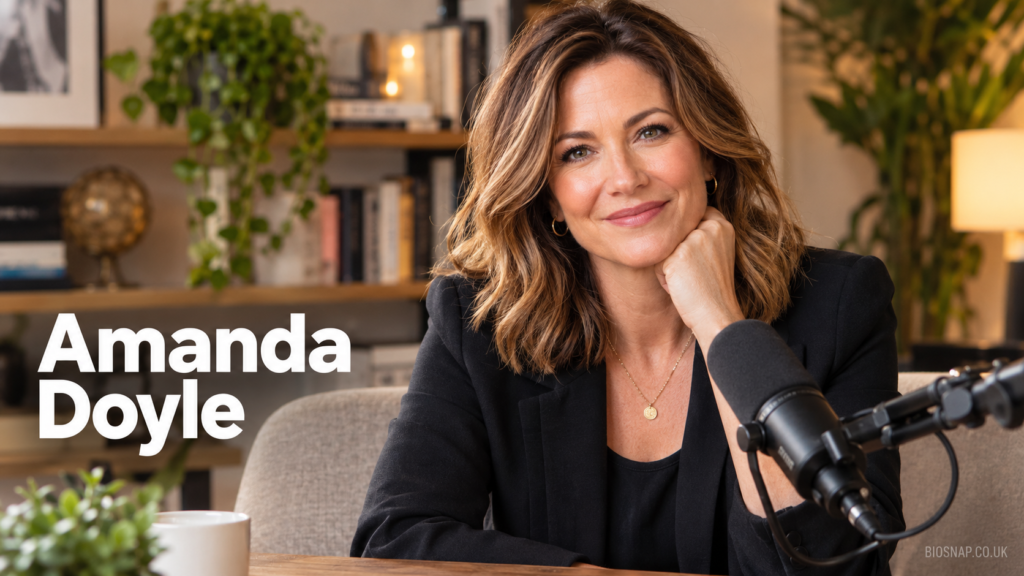

Amanda Doyle has become one of the most trusted voices in modern podcasting, even though she spent most of her career working quietly behind the scenes rather than in front of a microphone. She is best known today as a co-host of the wildly popular podcast We Can Do Hard Things, which she runs alongside her sister, author Glennon Doyle, and her sister-in-law, retired soccer star Abby Wambach. Long before podcasting became part of her life, Amanda built a career rooted in law, human rights advocacy, and nonprofit leadership, and that background gives her commentary a depth that many public figures simply do not have.
What makes Amanda Doyle stand out is the mix of legal training, lived experience, and emotional honesty she brings to every conversation. She is not a celebrity in the traditional sense. She is a lawyer, a mother of two, a breast cancer survivor, and a media entrepreneur who has spent years turning complicated ideas into practical guidance that ordinary people can actually use. This article looks closely at her background, her career, her health journey, and the projects that keep expanding her influence today.
Early Life and Family Background
Amanda Doyle grew up in Burke, Virginia, alongside her younger sister, Glennon Doyle, who would later become a bestselling author and public speaker. The two sisters shared a close bond from childhood, and that relationship has remained central to Amanda’s public identity ever since. On the podcast, she is often referred to simply as “Sister,” a nickname that reflects just how intertwined her personal and professional life has become with Glennon’s own story.
Rather than pursuing a career in media or entertainment, Amanda chose a more traditional professional path early on, studying law and building a reputation as a sharp, detail-oriented attorney long before anyone outside her family circle knew her name. Her legal background would later shape almost everything she became known for, from her advocacy work overseas to the way she approaches difficult conversations on air today.
Amanda now lives in Falls Church, Virginia, with her husband and their two children, one of whom is neurodivergent. She has spoken openly about the joys and challenges of parenting a neurodivergent child, and that experience has added another layer of authenticity to the family and parenting conversations she leads on the podcast.
Amanda Doyle’s Legal Career and Human Rights Work
Before becoming a familiar voice in podcasting, Amanda Doyle worked as a corporate attorney at the global law firm Hogan Lovells. It was demanding, high-level legal work that required precision and discipline, skills that later translated well into the way she breaks down complex emotional and social topics for a general audience on the show.
Her career took a meaningful turn when she became a legal fellow with International Justice Mission, a global organization focused on protecting people from violence and exploitation. Amanda worked in Rwanda, where she helped secure land rights for women and pursued accountability for child victims of sexual violence. This was not symbolic work; it involved direct legal advocacy in a country still rebuilding from deep trauma, and it exposed her firsthand to the real-world consequences of injustice and inequality.
That experience abroad is often cited as a turning point in her life. It shaped her worldview, deepened her long-term commitment to social justice, and gave her a first-hand understanding of resilience that she still draws on when discussing hard topics on We Can Do Hard Things. It remains one of the clearest examples of lived experience feeding directly into the credibility she carries today.
Leadership at Together Rising
After returning from her work overseas, Amanda Doyle took on a leadership role at Together Rising, a nonprofit organization co-founded by her sister Glennon Doyle. Amanda served as Vice President and General Counsel and sat on the organization’s board of directors, overseeing legal matters, risk management, policy development, and program strategy. Together Rising has distributed more than fifty-five million dollars to women, children, and families facing crisis situations around the world.
In this role, Amanda was not simply a figurehead. She was responsible for much of the operational and legal backbone of an organization built on rapid-response generosity, which meant balancing compassion with careful governance. That mix of heart and structure became something of a signature trait for her, one that listeners of the podcast would later recognize in the way she moderates emotional conversations without losing sight of practical, actionable solutions.
Her time at Together Rising also deepened her public commitment to causes involving women’s empowerment, family support, and crisis relief, themes that continue to show up regularly in her podcast episodes and public appearances. It laid the groundwork for the trust she would later build with a much wider audience beyond the nonprofit world.
The We Can Do Hard Things Podcast
Amanda Doyle’s most widely recognized role today is as co-host of We Can Do Hard Things, a podcast she created with Glennon Doyle and Abby Wambach. The show covers everything from mental health and relationships to grief, addiction, sobriety, and personal growth, and it has received more than half a billion plays since launching. Amanda has been named one of the fifty most powerful people in podcasting, a recognition that reflects both her steady on-air presence and her role in shaping the show’s overall direction.
What sets Amanda apart on the podcast is her role as a kind of emotional and intellectual anchor. While Glennon often leads with raw vulnerability and Abby brings an athlete’s perspective on discipline and resilience, Amanda frequently offers the analytical, big-picture framing that ties conversations together. Her legal training shows up clearly in the way she asks clarifying questions and pushes guests toward specific, actionable takeaways rather than vague, feel-good platitudes.
The chemistry between the three hosts is part of what has made the podcast so successful, but Amanda’s contribution is distinct. She often plays devil’s advocate, challenges assumptions, and grounds emotional discussions in practical reality, which has made her a fan favorite in her own right rather than simply “Glennon Doyle’s sister.” She has also spoken on the show about her own path to sobriety, adding another honest, personal dimension to the conversations she leads.
Co-Authoring the Book We Can Do Hard Things
Building on the success of the podcast, Amanda Doyle, Glennon Doyle, and Abby Wambach co-authored a book titled We Can Do Hard Things: Answers to Life’s 20 Questions. The book distills years of podcast conversations into a structured guide addressing some of the biggest questions people face about identity, relationships, purpose, and resilience, and it has been described by readers as something close to a guidebook for being alive.
Amanda’s contribution to the book reflects the same qualities that define her podcast presence: clarity, structure, and a willingness to challenge easy answers. Reviewers and readers have noted that her sections often bring a grounded, almost legal-brief style of reasoning to topics that could otherwise feel abstract or overly emotional. This balance has helped the book resonate with a broad audience, including readers who might not typically gravitate toward memoir-style self-help writing.
The book’s success reinforced Amanda’s position as more than a supporting character in her sister’s story. It established her as a co-creator of a larger cultural conversation about mental health, personal growth, and honest communication, one that continues to expand through new projects and media ventures tied to the We Can Do Hard Things brand.
Amanda Doyle’s Breast Cancer Diagnosis and Health Journey
In May 2024, Amanda Doyle publicly shared that she had been diagnosed with breast cancer at age 45. She discussed the diagnosis openly on the podcast in a two-part conversation, describing the shock of the news and the whirlwind of medical decisions that followed. A baseline breast MRI, rather than a standard mammogram alone, first flagged something unusual, and further testing and biopsies ultimately confirmed cancer in both breasts, leading to a decision to undergo a double mastectomy and breast reconstruction just weeks after her diagnosis.
Amanda has explained that her breast density, combined with her family history, significantly increased her risk, and she has credited her decision to be proactive, partly inspired by the loss of a close friend to cancer, with allowing doctors to catch the disease before it progressed further. She has said she felt she had essentially saved her own life by pursuing additional screening beyond routine mammograms. Her willingness to narrate the emotional and physical realities of diagnosis, surgery, and recovery in real time added a raw layer of vulnerability to a podcast already known for honest conversations.
Her openness about this health journey has had a tangible public impact, with reports of listeners who credited her story with prompting them to ask about breast density and seek additional screening for themselves, in at least one documented case leading to another woman’s own early cancer diagnosis. It is a clear example of personal experience translating into real-world health awareness, reinforcing the kind of trustworthy, experience-based influence that has defined Amanda Doyle’s career.
Treat Media and New Creative Ventures
In addition to her podcasting and writing work, Amanda Doyle is a founder of Treat Media, an award-winning media company built around creating thoughtful, human-centered content for audiences seeking something more substantial than typical entertainment. The venture reflects her ongoing interest in storytelling that treats its audience with respect and intelligence rather than chasing quick engagement or fleeting trends.
Amanda has also stepped into film production, serving as an executive producer on Come See Me in the Good Light, a documentary that won an award at the Sundance Film Festival. Her involvement in this project signals a broadening of her creative ambitions beyond audio content, extending her influence into visual storytelling and documentary filmmaking alongside her established work in podcasting and publishing.
These ventures suggest that Amanda Doyle’s public role is still evolving. Rather than settling into a single lane, she continues to expand into new formats while keeping the same underlying values of honesty, depth, and social relevance that have defined her work from her earliest days as a human rights lawyer.
Conclusion
Amanda Doyle’s appeal comes from an unusual combination of qualities that are rarely found together in one public figure. She has the analytical rigor of a trained lawyer, the compassion of someone who has worked directly with vulnerable populations in Rwanda and through Together Rising, and the vulnerability of someone who has faced a serious health crisis in the public eye. That combination gives her commentary a kind of credibility that is difficult to manufacture through media training alone.
Listeners and readers often describe her as the person who keeps difficult conversations grounded, someone who can hold space for emotion while still pushing toward clarity and action. This has made her an important figure not just within her family’s media ecosystem, but within the broader modern conversation about mental health, resilience, and personal growth. As her work continues to expand through new media projects, health advocacy, and creative ventures like Treat Media and Come See Me in the Good Light, Amanda Doyle’s influence looks set to keep growing well beyond her original role as “Glennon Doyle’s sister.” Her story is a reminder that expertise built quietly over years, when paired with honesty about personal struggle, can become one of the most powerful and lasting forms of public trust.
You May Also Read: Ben Napier