
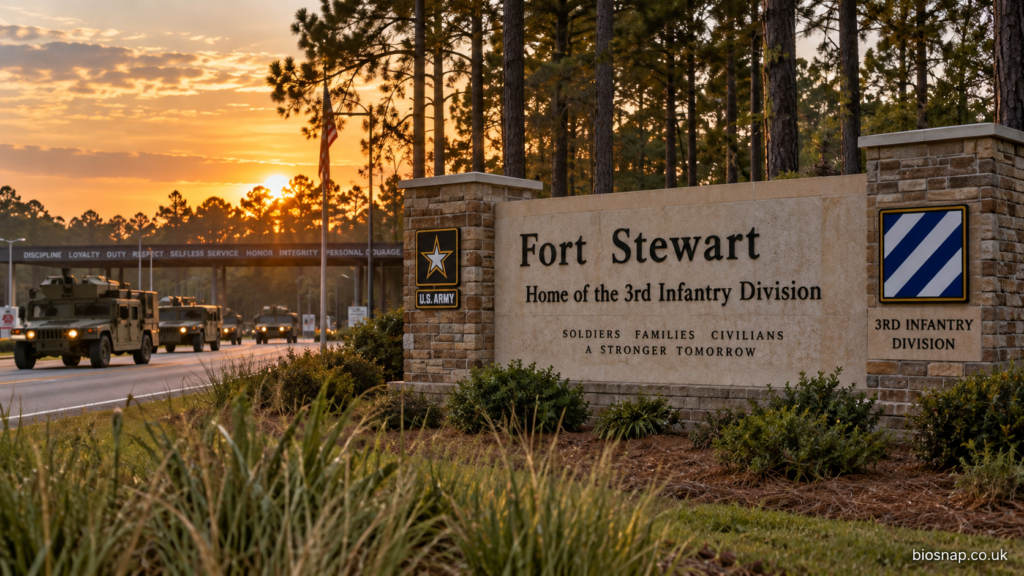

Fort Stewart sits quietly in the pine forests of Liberty County, Georgia, yet it plays an outsized role in America’s military readiness. Many people driving along Interstate 95 near Savannah have no idea that the sprawling woodland beside the highway is one of the most important Army posts in the country. Established in 1940 and now spanning more than 280,000 acres, Fort Stewart is the largest Army installation east of the Mississippi River and home to the storied 3rd Infantry Division. This article covers its history, its people, its housing and recreation options, and daily life across this massive Georgia post.
What Is Fort Stewart?
Fort Stewart is a United States Army installation located near Hinesville, Georgia, roughly forty miles southwest of Savannah in the Georgia Lowcountry. It is officially paired with Hunter Army Airfield in Savannah, and together the two sites operate under one command known as Fort Stewart-Hunter Army Airfield, supporting ground maneuver training at Stewart and rotary-wing aviation operations at Hunter.
The base is best known as home to the 3rd Infantry Division, one of the Army’s most decorated and frequently deployed combat divisions. Beyond its training ranges, Fort Stewart functions almost like a small city, with its own schools, medical center, retail stores, chapels, and recreational facilities supporting tens of thousands of soldiers, family members, and civilian employees.
A Brief History of Fort Stewart
Fort Stewart was established in 1940, just before the United States entered World War II, when the Army needed a large anti-aircraft artillery training center along the Atlantic coast. The installation was named after General Daniel Stewart, a Georgia native and Revolutionary War officer, and its remote, wooded terrain made it ideal for artillery ranges and maneuver exercises.
Over the following decades, the post expanded steadily, playing a training role during the Korean War and again during the buildup for Vietnam. By the later twentieth century, Fort Stewart had transitioned from a temporary training camp into a permanent home for armored and mechanized units, and its ranges and cantonment buildings today still reflect this long layering of military history.
The 3rd Infantry Division: Rock of the Marne
No description of Fort Stewart is complete without its signature unit, the 3rd Infantry Division, nicknamed the “Rock of the Marne.” The nickname traces back to World War I, when the division held firm against a major German offensive along the Marne River in France, a defensive stand that gave the division its enduring identity. That legacy is celebrated every year during Marne Week, when current and former soldiers gather for competitions and ceremonies across the installation.
The division has deployed repeatedly in modern conflicts, including extended combat tours during the Iraq War, making it one of the most operationally active divisions in the Army. Soldiers at Fort Stewart typically serve within armored brigade combat teams, division artillery units, or sustainment brigades, and this constant readiness posture shapes the rhythm of life on post.
Fort Stewart’s Size, Location, and Layout
Fort Stewart’s sheer size sets it apart from nearly every other Army post in the country. Covering more than 280,000 acres, the installation gives units enough room to run tank gunnery ranges, live artillery fire, and helicopter training exercises at the same time without one interfering with another. This scale is rare on the eastern seaboard and is a major reason the Army has continued investing in the post for more than eight decades.
The installation’s location also works in its favor. Fort Stewart sits close enough to Savannah to give soldiers and families easy access to a regional airport, historic downtown districts, and Atlantic beaches, while still preserving vast stretches of untouched forest, wetland, and wiregrass savannah. Most day-to-day activity happens in the compact cantonment area, containing housing, offices, and services, while training ranges spread out around it. Highways 144 and 119 cut through parts of these ranges, and local drivers occasionally encounter brief delays when armored convoys or tank crossings occur.
Life on Fort Stewart for Soldiers and Families
Daily life at Fort Stewart blends military duty with familiar suburban routines. Winn Army Community Hospital serves as the installation’s primary medical facility, while several schools operate directly on post for military children. Family readiness groups, chaplain services, and support programs help spouses and children manage the challenges of frequent deployments and extended field training.
Morale, Welfare, and Recreation programs add another dimension to post life, offering fitness centers, swimming pools, youth sports leagues, and a recently opened food truck plaza that has become a popular gathering spot. These amenities give military households a sense of stability, even when a service member is away training or deployed overseas for months at a time.
Housing and Living Near Fort Stewart
On-post housing at Fort Stewart is privatized and managed by Lendlease under the Stewart-Hunter Communities program, which offers two- to four-bedroom homes assigned according to rank and family size. These neighborhoods are spread throughout the installation and include updated appliances, community centers, and around-the-clock maintenance support.
Many service members instead choose to live off post in Hinesville or nearby towns, using their Basic Allowance for Housing, or BAH, to rent or purchase homes in the civilian market. Housing costs in this part of coastal Georgia remain relatively affordable, and living near Savannah opens up a wider range of neighborhoods and commute options. Anyone planning a permanent change of station should compare current BAH rates against local rental and mortgage prices before choosing between on-post and off-post housing.
Outdoor Recreation, Hunting, and Wildlife Conservation
One of the more surprising sides of Fort Stewart is how seriously the installation approaches environmental stewardship. The base lies within one of the most ecologically diverse regions in the northern hemisphere, home to longleaf pine forests, wiregrass savannahs, and wetlands that support threatened species such as the red-cockaded woodpecker. A dedicated Fish and Wildlife Branch balances the demands of live-fire training with long-term habitat conservation, a combination that has earned the post recognition for its conservation achievements.
Because the land has been open to public outdoor recreation since 1959, both civilians and military members can access designated areas for hunting, fishing, hiking, and birdwatching when those areas are not in active use. Access requires registering through the iSportsman system, and annual permits generally run around twenty dollars for recreation, fifty for fishing, and eighty for hunting, with a combination permit covering all three. Anglers fish in roughly twenty managed ponds, while hunters pursue deer and waterfowl across tens of thousands of acres, though a valid Georgia license and hunter safety course are required beforehand.
Visiting Fort Stewart and Security Considerations
Fort Stewart is not open to the general public the way a park or museum would be, since it remains an active and secure military installation. Visitors typically need a sponsor, a scheduled appointment, or a specific approved reason, such as a recreation permit, to pass through the gates, and photo identification is checked at every checkpoint. Security procedures have been strengthened in recent years, including new active vehicle barriers at certain gates and updated requirements for registering any firearm brought onto the installation.
These measures reflect how seriously Army leadership treats force protection at an installation of this size and importance. Emergency response planning, gate security, and coordination with local law enforcement remain constant priorities, and procedures can change on short notice. Anyone planning to visit for an approved purpose should check current gate hours and access requirements beforehand.
Fort Stewart’s Role in National Defense Today
Fort Stewart remains a critical hub for armored and mechanized warfare training along the East Coast. Its rare combination of vast maneuver space, modern medical simulation training facilities, and a permanently stationed division allows the Army to prepare soldiers for a wide range of possible missions. The installation has even been ranked as a top medical simulation training center within the Army, reflecting continued investment in realistic combat medical preparation.
Beyond its training mission, Fort Stewart also contributes to the surrounding region’s economy and community life. Local contracting programs help small businesses in the Hinesville and Savannah areas compete for federal opportunities, while partnerships with area schools and civic organizations strengthen ties between the installation and its civilian neighbors. This ongoing relationship helps Fort Stewart function as a genuine part of coastal Georgia rather than an isolated compound.
Conclusion
Fort Stewart is far more than a name on a map or a single stop along a military career. It is a living installation shaped by more than eighty years of history, home to one of the Army’s most respected combat divisions, and a place where military duty and everyday family life intersect every day. From its enormous training ranges and carefully managed forests to its schools, hospital, and neighborhoods, Fort Stewart reflects a careful balance between combat readiness and long-term community stewardship.
You May Also Read: Charlie Kirk Shooting