
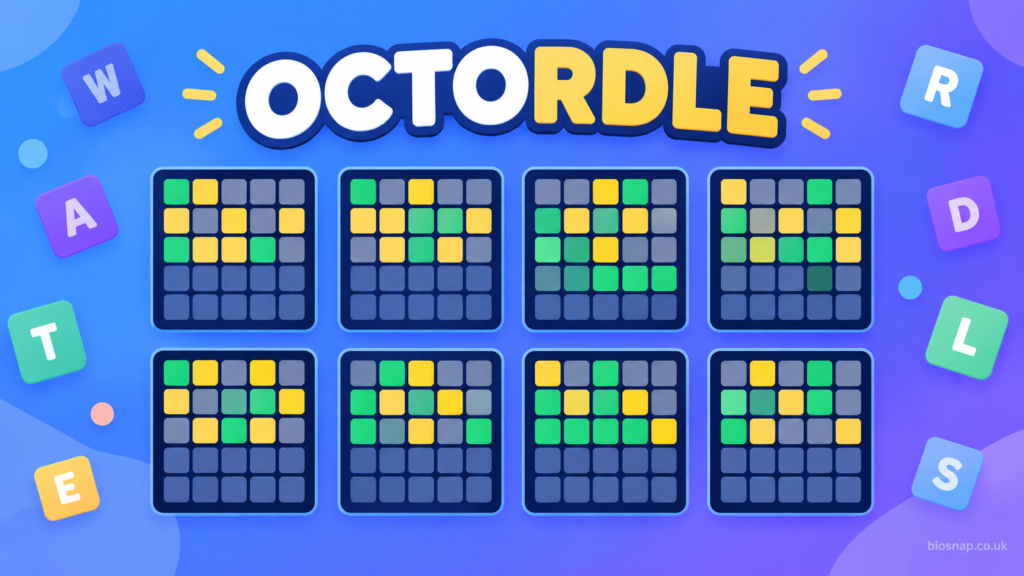

Word games have become a daily habit for millions of people, and Octordle sits near the top of that list for players who want something more demanding than the average puzzle. Instead of solving one hidden word a day, Octordle asks players to solve eight words at once, using the same color-coded guessing system that made Wordle so popular. It keeps the rules simple but multiplies the challenge, which is exactly why it has built such a dedicated following since it first appeared. This guide walks through everything worth knowing about Octordle, from its background and rules to strategies, common mistakes, and the mental benefits of playing it regularly.
What Octordle Is and How It Began
Octordle was created by developer Kenneth Crawford and released online in the early months of 2022, arriving during the peak of the Wordle craze that had taken over social media and daily routines around the world. Crawford’s idea was straightforward but ambitious: take the familiar green, yellow, and gray tile system that Wordle players already understood, and apply it to eight separate five-letter words rather than just one. The result was a puzzle that felt instantly recognizable yet noticeably harder from the very first guess.
The game spread quickly because it filled a gap that many dedicated word game fans had started to notice. A single Wordle puzzle a day was enjoyable, but for players who wanted a longer, more intense session, there was nothing quite like it until Octordle arrived. Its rise mirrored a broader trend of Wordle-inspired spin-offs, including versions with four words, six words, and even sixteen words, but Octordle in particular struck a balance that felt genuinely challenging without becoming impossible.
Today, Octordle is played by people all over the world as part of a daily routine, alongside other word and logic games. It has stayed relevant not because of flashy design, but because the core puzzle mechanic continues to reward careful thinking, memory, and vocabulary in a way that feels satisfying to solve.
The Basic Rules of Octordle
Every round of Octordle presents eight grids on the screen at the same time, each one hiding a different five-letter word. Players are given thirteen total guesses to solve all eight words, and every single guess is checked against all eight hidden answers simultaneously. This shared-guess system is what separates Octordle from simply playing eight rounds of Wordle back to back, since one word entered into the guess box can produce eight different sets of color feedback all at once.
The feedback colors work exactly as they do in Wordle. A green tile confirms that a letter is correct and sitting in the right position for that particular word. A yellow tile shows that the letter exists somewhere in the word but is currently placed incorrectly. A gray tile means the letter does not appear in that word at all. Because the guess applies to all eight boards together, a single word might come back green in one grid, yellow in another, and gray in the rest, all from the exact same five letters.
As individual words are solved, their grid locks and drops out of the active puzzle, which gradually narrows the player’s focus onto the remaining boards. This creates a natural rhythm to each game, starting wide and information-focused, then narrowing down toward precise, targeted guesses as fewer boards remain and fewer guesses are left to use.
Daily Mode Versus Unlimited Practice
Octordle offers more than one way to play, which is part of why it has kept players engaged for so long. The Daily Octordle is the same puzzle set for every player on a given day, refreshing once every twenty-four hours. This shared daily challenge creates a sense of community, since players often compare their results, guess counts, and strategies with friends or online groups, much like the culture that built up around daily Wordle results.
For players who do not want to wait a full day between sessions, Octordle also offers a Free Play or Unlimited mode. This version generates a brand-new set of eight random words every time it is started, allowing unlimited practice sessions in a single sitting. This mode is especially useful for beginners who want to get comfortable with the mechanics before attempting the daily challenge, since mistakes in practice mode carry no pressure and can be repeated as often as needed.
There is also a Sequence mode available in some versions of the game, which changes the puzzle format slightly by requiring words to be solved in a specific order rather than allowing free guessing across all eight boards. This adds a layer of planning that rewards players who think several steps ahead rather than reacting only to whichever board reveals useful information first.
Choosing the Right Starting Words
The opening guesses in Octordle matter more than in almost any other stage of the game, since they set the foundation for every guess that follows. Experienced players tend to favor starting words that contain a mix of common vowels and frequently used consonants, since these letters are statistically more likely to appear across a wide range of English five-letter words. Words like “arose,” “adieu,” “stare,” and “cloud” are frequently recommended because they cover a broad range of useful letters in just a few guesses.
Because every guess is applied to all eight hidden words at once, even a starting word that does not directly match any final answer can still be extremely valuable. The information gathered from gray, yellow, and green tiles across all eight boards builds a mental map that becomes clearer with each new guess. Skipping this information-gathering phase in favor of trying to guess full words too early is one of the most common reasons players run out of guesses before finishing the puzzle.
A well-chosen set of two or three opening words, focused purely on covering different letters rather than solving specific boards, often makes the difference between finishing all eight puzzles comfortably and running out of guesses near the end. This approach requires a bit of patience early on, but it consistently pays off as the puzzle progresses.
Strategies for the Mid and Late Game
Once a few boards begin locking into place, the strategy in Octordle shifts from broad information-gathering to precise deduction. At this stage, it becomes important to track which letters have already been confirmed, which have been ruled out, and which are known to exist but not yet placed correctly. Players who keep a clear mental note of this information tend to solve remaining boards much faster than those who guess based on instinct alone.
Repeating letters can also become a factor in the later stages, since some five-letter words include double letters that are easy to overlook. Recognizing common English patterns, such as frequent word endings or typical consonant pairings, can help narrow down possibilities more efficiently when only a few guesses remain. This is often where a strong vocabulary becomes especially useful, since recalling less common five-letter words can make the difference between solving a board and running out of guesses.
Managing the remaining guesses carefully is just as important as vocabulary knowledge. Since Octordle does not impose a time limit, players can take as long as they need to think through each guess, but it helps to avoid overanalyzing when a logical next move is already clear. Steady, methodical guessing tends to outperform long pauses spent second-guessing an obvious choice.
Common Mistakes Players Should Avoid
One of the most frequent errors in Octordle is losing track of which letters have already been eliminated on a specific board. Since feedback applies across all eight puzzles at once, it is easy to forget that a gray letter in one board does not necessarily rule it out everywhere else. Keeping mental or written notes of eliminated letters per board can prevent repeated, wasted guesses later in the game.
Another common mistake is rushing to complete individual words too early, which limits the amount of useful information gathered for the other boards still in play. Players who focus only on solving one puzzle quickly often find themselves short on guesses when it comes time to finish the remaining seven. A more balanced approach, prioritizing letter coverage in the early guesses, tends to produce far better results overall.
Ignoring word patterns is another issue that trips up many players, especially those newer to word games in general. English contains many predictable structures, such as common suffixes and typical vowel placement, and overlooking these patterns can slow down progress significantly. Treating each guess as an isolated puzzle, rather than building on previous clues, is one of the fastest ways to run out of available guesses.
Vocabulary Building Through Regular Play
Playing Octordle regularly naturally strengthens vocabulary over time, since the game constantly introduces five-letter words that may not come up often in everyday conversation. Players who pay attention to unfamiliar words that appear as answers often find themselves recalling those same words in future puzzles, gradually expanding their working vocabulary without any deliberate memorization effort.
Beyond vocabulary, the game sharpens awareness of English spelling patterns, including common letter combinations and structural rules that native speakers often use instinctively but rarely think about directly. This kind of pattern recognition tends to improve steadily the more someone plays, which is part of why long-time Octordle players often solve puzzles noticeably faster than they did when they first started.
Many players also use outside resources, such as reading regularly or solving other word-based puzzles, to reinforce the vocabulary skills that Octordle rewards. This combination of active gameplay and passive language exposure creates a well-rounded approach to improving both puzzle-solving speed and general vocabulary strength.
Mental and Cognitive Benefits of Playing Octordle
Beyond entertainment, Octordle offers genuine cognitive benefits that go beyond simple word recall. Managing eight active puzzles at the same time requires sustained focus and strong working memory, since players must hold multiple partial solutions in mind while deciding on their next guess. This kind of mental juggling is a useful exercise for concentration and short-term memory alike.
The game also encourages logical thinking and structured decision-making. Every guess involves weighing probabilities based on incomplete information, which mirrors problem-solving skills used in many everyday situations far beyond word games. This is part of why puzzles like Octordle have found a place not just among casual players, but also in classrooms and among people looking for enjoyable ways to stay mentally active.
Many players also describe Octordle as a relaxing part of their daily routine, offering a slower and more thoughtful kind of engagement compared to fast-paced games. This balance between genuine challenge and calm, unhurried gameplay is a major reason the puzzle has remained popular well after the initial wave of Wordle-style games faded for many casual players.
Conclusion
Octordle has earned its place among the most engaging word games to come out of the Wordle era, offering a bigger and more demanding challenge while keeping the rules simple enough for anyone to pick up. Its combination of shared guesses across eight boards, flexible game modes, and genuine vocabulary-building potential makes it appealing to casual players and dedicated word game fans alike. Success in Octordle comes down to smart starting choices, careful tracking of feedback, and steady vocabulary growth built through regular play. For anyone looking for a daily mental challenge that rewards patience and pattern recognition, Octordle remains one of the most satisfying word games available today.
You May Also Read: Polly Klaas